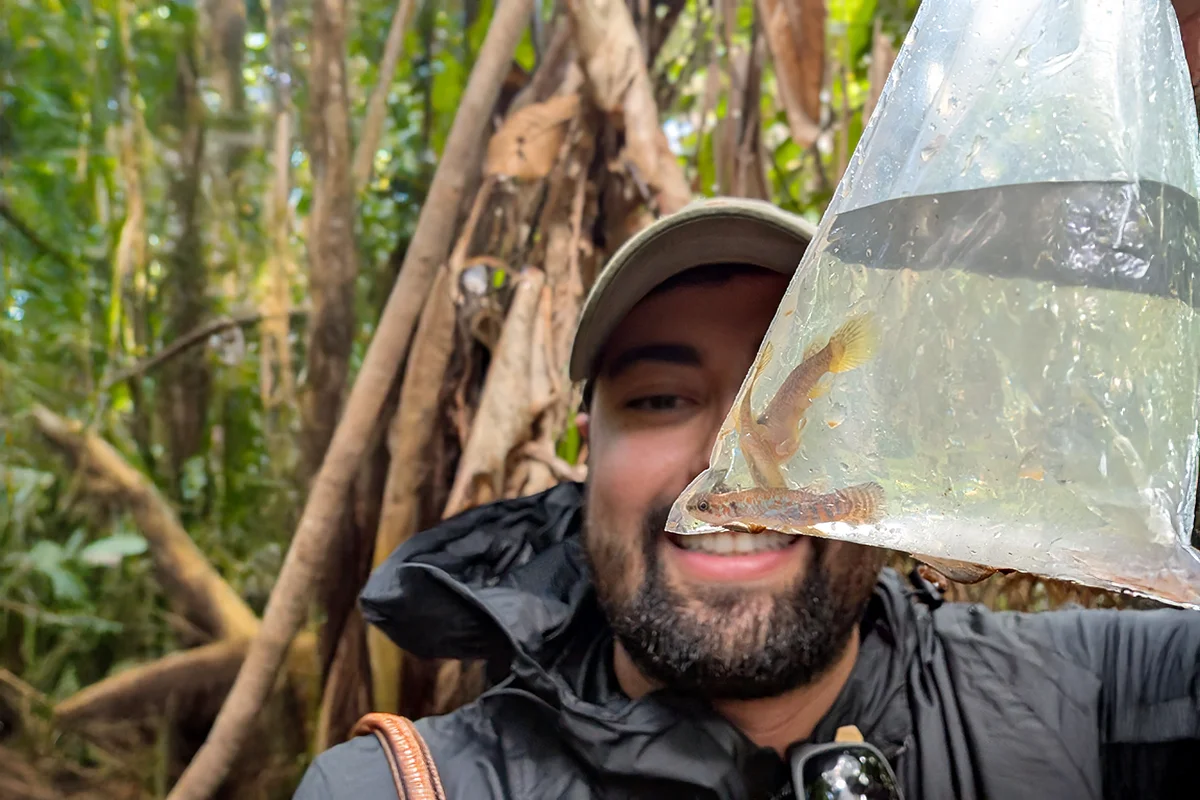
A UWF biologist helped name Laimosemion laranja, a 1.18-inch killifish found in three Amazon forest pools. The team says it should be listed as endangered.
A University of West Florida biologist has helped discover a new species of fish in the Brazilian Amazon. The tiny killifish is named Laimosemion laranja, and it lives in just three small forest pools.
Waldir Miron Berbel-Filho, an assistant professor of biology at UWF, led the work with three Brazilian institutions, the university said in an Oct. 22 announcement. The team confirmed the species by comparing the fish’s body shape and its DNA with its relatives.
A fish named for its color
The fish is about 1.18 inches long. It has rows of orange spots along the front of a pale gray body and bold orange bars near the tail.
Laranja is Portuguese for both the color orange and the fruit. The name also honors Laranjal do Jari, the Brazilian county where the fish was found, UWF said.
“Finding a new species is a thrilling and humbling discovery,” Berbel-Filho said in the university’s announcement. “It’s a reality check about our place on Earth and how much is still out there to be explored.”
Small range, real threats
The researchers found the fish in tiny forest streams in the Rio Cajari drainage, in the state of Amapá. They say it is known from an area of just 9.7 square miles.
That small range leaves it exposed to:
- deforestation
- sediment from mining
- plastic pollution
The team recommends listing the species as endangered under International Union for Conservation of Nature guidelines. It also wants a nearby reserve expanded to protect its habitat.
Who did the work
Berbel-Filho collected and documented specimens, recorded the habitat, prepared samples for genetic testing, analyzed the data and wrote the study, UWF said. His partners were:
- Universidade Federal do Rio Grande do Norte
- Instituto Peixe das Nuvens
- Universidade Federal do Pará
The discovery came out of a larger project funded by Brazil’s National Council for Scientific and Technological Development, with about $49,000 in total. That project studies how killifish evolved to live in pools that dry up, a trait tied to short lives and fast aging. Berbel-Filho said the work may help answer questions about aging and human health.
The study’s first author, Brazilian doctoral student Yuri Abrantes, has just arrived at UWF. He will spend nine months in Berbel-Filho’s lab, MIRONlab, as a visiting research scholar.
What it means for you
Pensacola’s public university is producing research that reaches well beyond the Gulf Coast, and the work continues on campus at 11000 University Parkway with a visiting scholar from Brazil. Students and families weighing UWF can read about the biology program at the UWF Department of Biology, part of the Hal Marcus College of Science and Engineering.
For more news from the university, see our coverage of UWF’s return to class after Hurricane Isaias.
Have your say