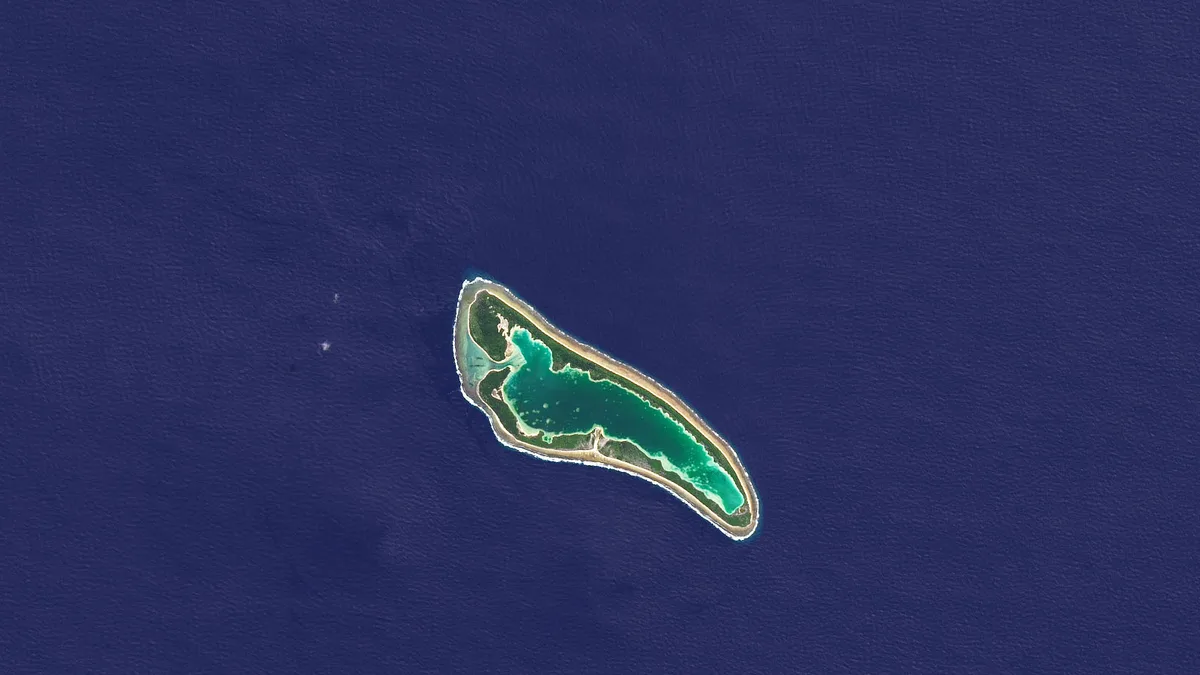
A UWF maritime archaeologist helped test whether an object in a Pacific lagoon was Amelia Earhart's plane. It was tree debris, but the team logged other finds.
A University of West Florida archaeologist spent October on a remote Pacific atoll, helping test whether an object in its lagoon was part of Amelia Earhart’s missing plane.
It was not. The team found the object was mostly tree debris. But William Wilson, a UWF maritime archaeologist and faculty research associate, said the search is far from over.
“I am honored and humbled to be among them, and I hope to return to the south Pacific in the future to aid future expeditions. The search is not over!” Wilson said.
The details come from the university’s account of the expedition, published Thursday.
What the team was looking for
Earhart and her navigator, Fred Noonan, disappeared July 2, 1937. They were flying from Lae, Papua New Guinea, to Howland Island on their attempt to fly around the world. The U.S. military searched for them, but neither the fliers nor the plane was found.
One long-running theory holds that they landed on the reef around Nikumaroro and were stranded there. The atoll is about 400 miles southeast of Howland Island, in the Republic of Kiribati.
In 2020, satellite images showed an unusual shape on the atoll’s Taraia Peninsula. Its shape and shine led some researchers to think it could be part of Earhart’s Lockheed Electra. The Taraia Object expedition was set up to find out.
Purdue University, the Purdue Research Foundation and the Archaeological Legacy Institute led the trip, UWF said.
How the Pensacola connection came about
Wilson’s specialty is using technology to find shipwrecks, aircraft and other underwater sites. Michael Krivor, an underwater archaeologist with RECON Offshore, brought him onto the project in spring 2025. Krivor’s business partner, Jason Burns, is a UWF graduate.
The team left Tarawa, Kiribati, on Oct. 6 and spent nearly six days at sea on an island freighter. About 34 people shared the boat, sleeping in small bed tents on the back deck.
What they found
The team surveyed the lagoon with three instruments:
- a magnetometer, which picks up objects containing iron
- side-scan sonar, which uses sound to picture the seafloor
- a subbottom profiler, which detects objects buried under it
Sonar showed nothing significant. A magnetic signal west of the object looked more promising, because parts of the Electra’s landing gear and engine were steel. Wilson and Krivor dug there by hand and found a steel pipe about three feet long. It was not from the plane, so they documented it and put it back.
At the object itself, the reflective “metal” turned out to be a natural coating of hardened coral sediment, UWF said. The two men pushed water through an eight-foot pipe to probe the lagoon floor around the site. They found only coral rubble.
The fieldwork took seven days. The team also logged other artifacts on land and underwater, including a steel tube from the lagoon. Researchers will keep studying those finds to learn how objects move through the lagoon, the university said.
What it means for you
- A Pensacola researcher on a world mystery. UWF’s Archaeology Institute has a long focus on public archaeology, the university said, and one of its researchers has now worked at one of the most studied sites in the Earhart search.
- Want to study it? The university’s anthropology and archaeology program page has course and degree details.
- More from the campus: a UWF biologist recently helped name a new species of killifish, and our things to do page lists UWF concerts and shows.
Have your say